Conference paper: Play as Process and Product: On Making Serendip-o-matic

The abstract for our Digital Humanities 2014 conference paper is below. Scott's posted his notes from the first part, my notes for the middle part How did 'play' shape the design and experience of creating Serendip-o-matic? are on Open Objects and Brian's are to follow.

Play as Process and Product: On Making Serendip-o-matic

Amy Papaelias, State University of New York at New Paltz

Brian Croxall, Emory University

Mia Ridge, The Open University

Scott Kleinman, California State University, Northridge

Summary
Animated gif of a green cartoon hippopotamus with a speech bubble saying 'feeding the machine'

Who says scholarship can't be playful? Serendip-o-matic is a "serendipity engine" that was created in less than a week by twelve digital humanities scholars, developers, and librarians. Designed to replicate the surprising experience of discovering an unexpected source while browsing library stacks or working in an archive, the visual and algorithmic design of Serendip-o-matic emphasizes playfulness. And since the tool was built by a group of people who were embarking on a difficult task but weren't yet sure of one another's names, the process of building Serendip-o-matic was also rather playful, encouraging participants to take risks, make mistakes, and learn something new. In this presentation, we report on how play shaped the creation, design, and marketing of Serendip-o-matic. We conclude by arguing for the benefits of more playful work in academic research and scholarship, as well as considering how such "play" can be evaluated in an academic context.

Continue reading "Conference paper: Play as Process and Product: On Making Serendip-o-matic"

Keynote 'Enriching cultural heritage collections through a Participatory Commons' at Sharing is Caring

Photo of glider plane against blue sky
Image: Library of Congress

I was invited to Copenhagen to talk about my research on crowdsourcing in cultural heritage at the 3rd international Sharing is Caring seminar on April 1. I've posted my notes on Open Objects: Enriching cultural heritage collections through a Participatory Commons platform: a provocation about collaborating with users.

Much of this comes from my PhD research and my previous work in museums, and I'm grateful to everyone who's commented in person or on twitter so far, particularly as it helps me understand the best ways to explain the Participatory Commons and the research underlying it for different audiences.

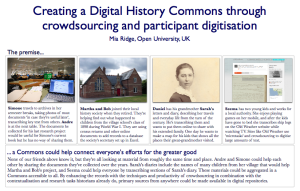
'Creating a Digital History Commons through crowdsourcing and participant digitisation' at Herrenhausen DH Conference

screenshot of poster
Creating a Digital History Commons through
crowdsourcing and participant digitisation

I was awarded a travel grant to attend the Herrenhausen Conference: "(Digital) Humanities Revisited – Challenges and Opportunities in the Digital Age" in Hannover, Germany, over December 5-7, 2013. I'd like to thank the Volkswagen Foundation (VolkswagenStiftung) for funding travel for 37 early career scholars and for the opportunity to present there.

My lightning talk notes, further information and references for 'Peer production models for academic and amateur historians: challenges and opportunities' are below. Obviously the full reference list for my PhD would be huge so below I've selected items that relate specifically to my poster and talk. PDF of my poster on 'Creating a Digital History Commons through crowdsourcing and participant digitisation'.
Continue reading "'Creating a Digital History Commons through crowdsourcing and participant digitisation' at Herrenhausen DH Conference"

Guest post 'Tips for digital participation, engagement and crowdsourcing in museums' for London Museums Group

I was asked to share some of the lessons I've learnt from building digital participation projects in museums and from my research on crowdsourcing in cultural heritage for the London Museums Group blog following my talk at their “Museums and Social Media” event on 24 May at Tate Britain.

They were published at 'Tips for digital participation, engagement and crowdsourcing in museums by Mia Ridge', but as the site doesn't seem to be loading I've re-posted it below. I think most of what I wrote then holds up, but today I'd add a third bonus tip – plan to ingest the results of your crowdsourcing tasks into whatever internal systems are necessary to appropriately integrate and re-share the enhanced or new data.

To pinch from my headings, I discuss the advantages of digital engagement; challenges for museums – new relationships, new authorities, dissolving boundaries; 6 tips for designing digital participation experiences in museums; 2 bonus tips for designing crowdsourcing projects in museums.

There are other event reports at A round up of the LMG Museums and Social Media Event.

If you found this post useful, you might be interested in my book, Crowdsourcing Our Cultural Heritage.

Continue reading "Guest post 'Tips for digital participation, engagement and crowdsourcing in museums' for London Museums Group"