Keynote: Crowdsourcing our cultural heritage, Nordiske Arkivdage 2015

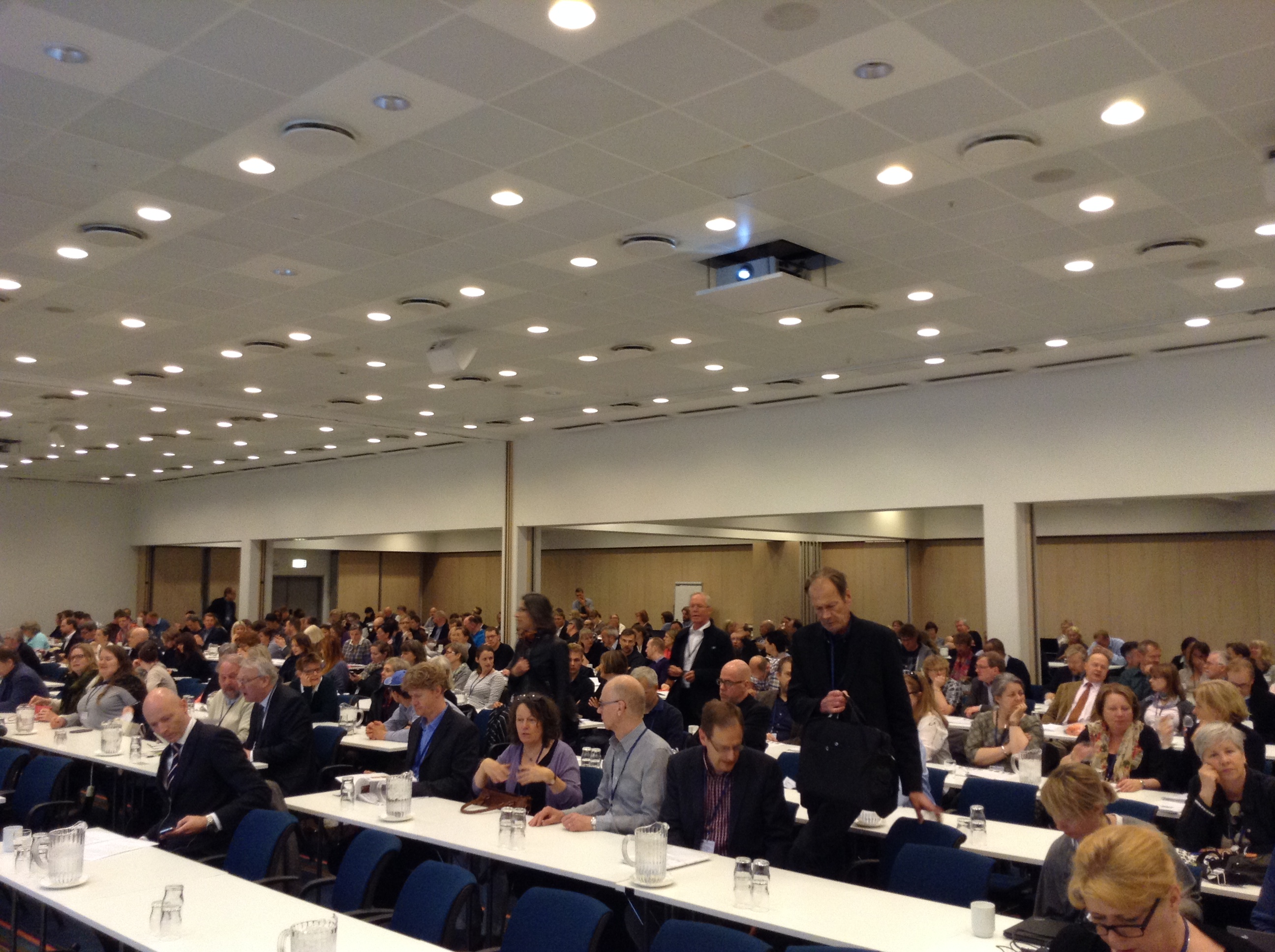
Photo of the audience arriving at Nordiske Arkivdage 2015
The audience arriving at Nordiske Arkivdage 2015

I was invited to give a keynote on 'Crowdsourcing our cultural heritage' at Nordiske Arkivdage 2015 (#NordiskArkiv), a triennial gathering of archivists from Finland, Iceland, Norway, Sweden, Denmark, the Faroe Islands, Greenland and Åland in Copenhagen on May 8, 2015. I greatly enjoyed hearing about various crowdsourcing projects that state and city archives in those countries have worked on over the years (and would still love to hear more). My slides are below.

From my introduction:

Today I want to talk about why crowdsourcing creates opportunities for productive, meaningful public engagement with cultural heritage. This isn't a sales pitch – crowdsourcing is not a 'magic bullet' – but I think an investment in crowdsourcing can be repaid with impressive results in the amount of material processed, and in new relationships with our shared cultural heritage in museums, libraries, universities, community groups and archives.

So in the next twenty minutes I will briefly explain what crowdsourcing in cultural heritage is, give you a glimpse of some projects where crowdsourcing has been incredibly productive, and discuss how it can help make collections more accessible while engaging people more deeply in thinking about those collections…

Crowdsourcing in cultural heritage asks the public to help with tasks that contribute to a shared, significant goal or research interest related to cultural heritage collections or knowledge. As a voluntary activity, the tasks and/or goals should be inherently rewarding.

If you're interested in engagement through crowdsourcing, you might also like From tagging to theorizing: deepening engagement with cultural heritage through crowdsourcing. Curator: The Museum Journal, 56(4) pp. 435–450. If you're interested in crowdsourcing in cultural heritage generally, try the book! My Introduction to Crowdsourcing Our Cultural Heritage is online.
2014: an overview

A properly incomplete list of what I got up to in 2014…

My edited volume, Crowdsourcing Our Cultural Heritage, was published, with a book launch at UCL.

From September – December 2014 I was a Visiting Research Fellow at Trinity College Dublin / CENDARI project.

In December I presented on ‘Linking lived experiences of the First World War: a pilot with WWI collections‘ at the Trinity College Long Room Hub.

In November 2014 I presented on Citizen History and its discontents for the IHR Digital History seminar series, launched my book, Crowdsourcing our Cultural Heritage at UCL then keynoted at New Zealand’s National Digital Forum with ‘Collaborative collections through a participatory commons’ (talking about the Participatory Commons). I was also in London for the Museums Computer Group’s UKMW14: Museums Beyond the Web.

In October 2014 I gave a paper asking Where is the revolution in citizen history? The place of crowdsourcing in public history at the Public History in a Digital World: The Revolution Reconsidered conference in Amsterdam, ran a workshop on visualising collections at the Geffrye Museum and presented in an online seminar on ‘Crowdsourcing 101: Fundamentals and Case Studies’.

In August 2014 I taught ‘Crowdsourcing Cultural Heritage’ with Ben Brumfield at the HILT Summer School (Humanities Intensive Learning + Teaching) at MITH in Maryland.

In July I presented “Lightweight usability testing for digital humanities projects (AKA, ‘testing doesn’t have to be taxing’)” in the Introduction to Digital Humanities strand of the Digital Humanities at Oxford Summer School 2014 then I went to Lausanne to present ‘Play as Process and Product: On Making Serendip-o-matic’ at Digital Humanities 2014 with fellow alumni of 2013’s One Week One Tool.

In May I was in Bristol for the Museums Computer Group’s Museums Get Mobile and in Boston for THATCamp NE.

In April 2014 I was a keynote speaker at the 3rd international Sharing is Caring seminar. I spoke on ‘Enriching cultural heritage collections through a Participatory Commons’.

In Feburary I was invited to Melbourne to give a keynote on ‘GLAM making’ at VALA2014 (VALA – Libraries, Technology and the Future), and spoke on ‘Bringing maker culture to cultural organisations’.

In January I wrote a guest post for the Museums Association site: Digital myth: Museums need to explode the myth they are technologically backward.

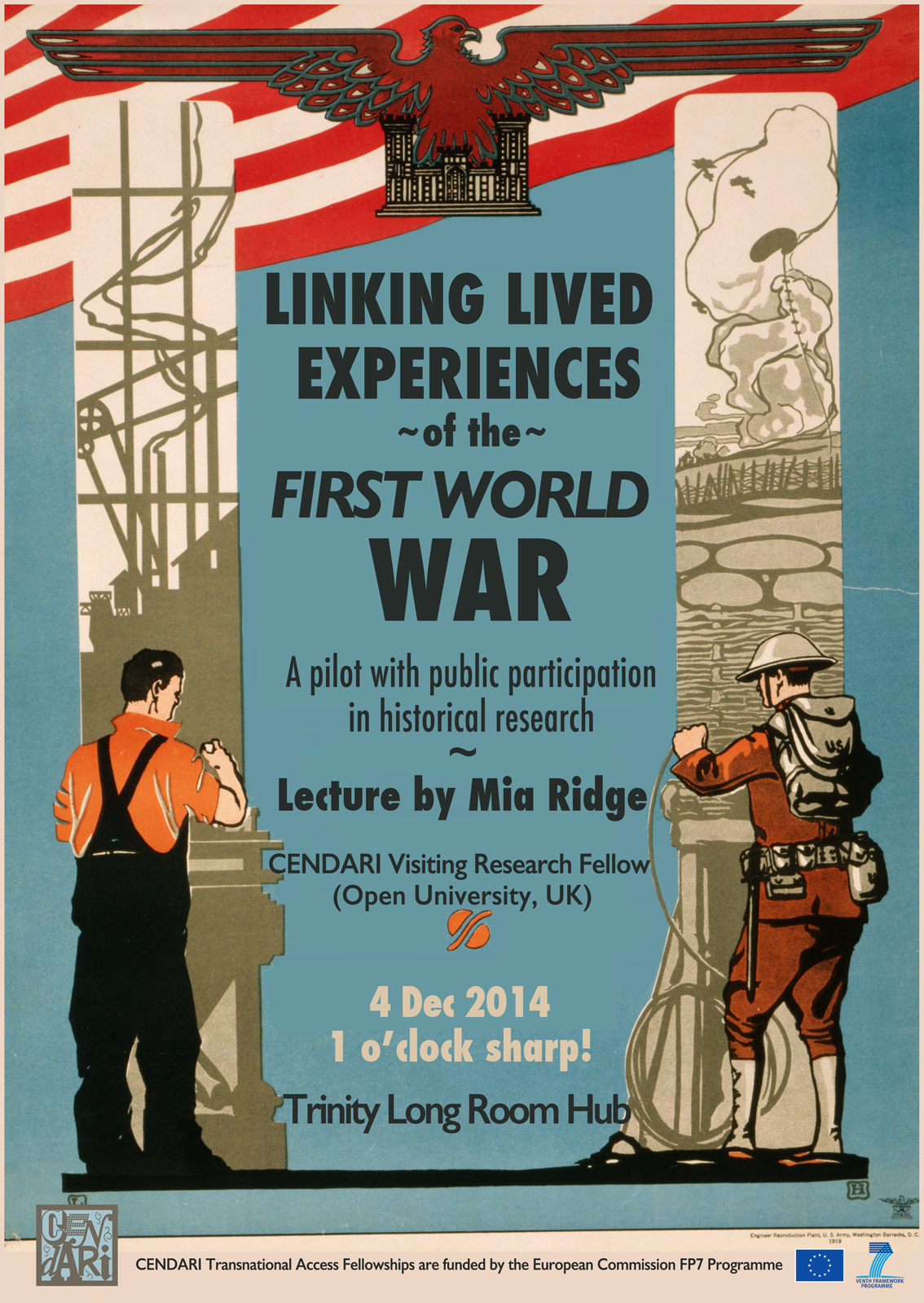
Lecture: 'A pilot with public participation in historical research: linking lived experiences of the First World War', Trinity College Dublin

Trinity lecture poster

As part of my Visiting Research Fellowship at Trinity College Dublin's Long Room Hub I gave a lecture on 'A pilot with public participation in historical research: linking lived experiences of the First World War'.

The abstract and podcast are below, and there's further information about my CENDARI Fellowship here.

Abstract: The centenary of World War One and the digitisation of records from a range of museums, libraries and archives has inspired many members of the public to research the lives of WWI soldiers. But it is not always easy to find or interpret military records. What was it like to be in a particular battalion or regiment at a particular time. Can a 'collaborative collection' help provide context for individual soldiers' experience of the war by linking personal diaries, letters and memoirs to places, people and events? What kinds of digital infrastructure are needed to support research on soldiers in the Great War? This lecture explores the potential for collaborating with members of the general public and academic or amateur historians to transcribe and link disparate online collections of World War One material. What are the challenges and opportunities for participatory digital history?

Thursday, 04 December 2014 | 13:00 | Trinity Long Room Hub

A lecture by Visiting Research Fellow at the Trinity Long Room Hub, Mia Ridge (The Open University). Mia is a Transnational Access fellow, funded by the CENDARI project (Collaborative European Digital Archive Infrastructure).

Keynote: 'Collaborative collections through a participatory commons', 2014 National Digital Forum conference

I was delighted to be invited to present at New Zealand's 2014 National Digital Forum conference in Wellington. I was asked to speak on my work on the 'participatory commons'. As a focus for explaining the need for a participatory commons, I asked, 'What could we create if museums, libraries and archives pooled their collections and invited specialists and enthusiasts to help link and enhance their records?'.

As a conceptual framework rather than a literal technical architecture, every bit of clearly licensed content with (ideally) structured data published around it makes a contribution to 'the commons'. In my keynote I explored some reasons why building tightly-focused projects on top of that content can help motivate participation in crowdsourcing and citizen history, and some reasons why it's still hard (hint: it needs great content supported by relevant structured data), using my TCD/CENDARI research project on 'lived experiences of World War One' as an example.

The video is now online.