Guest post: Center for the Future of Museums blog

I co-wrote a post with Suse Cairns in reply to a post from Jasper Visser on Opportunities and Challenges with Reproductions for the American Alliance of Museums' blog.

As the introduction to A Reply to “On the Opportunities and Challenges of Reproductions” says, Jasper's post and our response came out of a conversation on twitter about the launch of the exhibition.  Many thanks to Elizabeth Merritt and the Center for the Future of Museums for hosting our discussion.

Keynote: Global communities and open cultural data: movements towards linked open data in libraries, archives and museums

I was invited to Taipei, Taiwan for the 'eCulture & Open Cultural Data Forum' by TELDAP (Taiwan e-Learning and Digital Archives Programs), MCN Taiwan and Culturemondo Asia Pacific.  Many thanks to my hosts and organisers for their hospitality, for the meetings they organised with various national museums and for the opportunity to discuss open cultural data with staff from Taiwanese museums, libraries and archives.

As well as my keynote on 'Global communities and open cultural data: movements towards linked open data in libraries, archives and museums', I lead a further day and a half of seminars with Shih-Chieh Ilya Li at the Academia Sinica, Taiwan on:

  • eCulture, Data Immersion & Open Cultural Data
  • Why Open Cultural Data?
  • What is Linked Open Data (LOD) ?
  • Strategy and Planning Open Cultural Data
  • Technologies, standards and licenses for Linked Open Data
  • How to open your cultural Data
  • Group exercise: planning LOD projects

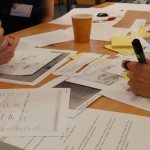
Card-sorting activity at the Commodity Histories workshop

The AHRC-funded Commodity Histories project aims to produce a 'website that will function as a collaborative space for scholars engaged in commodities-related research'.  The project organised a workshop, 'Designing a collaborative research web space: aims, plans and challenges of the Commodity Histories project' in London on 6-7 September 2012.

As part of opening session on the 'aims, plans and challenges of the Commodity Histories project and website' I led a card-sorting exercise aimed at finding out how potential scholars in the community of commodity historians would expect to find and interact with content and other scholars in the network.  We prepared print-outs of sample content in advance and asked participants to sort them into groups and then label them.  At the end of the workshop I presented the different headings the groups had come up with and discussed the different ways they'd organised the material.

While some work had been done on the site structure previously, the process was useful for understanding some of the expectations people had about the functionality and sociability of the site as well as checking how they'd expect the site to be organised.  Various other presentations and discussion during the workshop reinforced the idea that the key task of the site is to enable contributors to add content easily and often, and tempered our expectations about how much scholarly networking would be visible as conversations on the site.

has written up some of the workshop at The Boundaries of Commodities.

Paper: 'On the Internet, nobody knows you’re a historian: exploring resistance to crowdsourced resources among historians' at DH2012

I presented a short paper 'On the Internet, nobody knows you’re a historian: exploring resistance to crowdsourced resources among historians'  (abstract, video) at Digital Humanities 2012 in Hamburg, Germany.

I've posted a version of my research as it was at that stage as a post on Open Objects: Early PhD findings: Exploring historians' resistance to crowdsourced resources.

My abstract (written a long time previously) is below:

Crowdsourcing, the act of taking work once performed within an organisation and outsourcing it to the general public in an open call (Howe 2006), is increasingly popular in memory institutions as a tool for digitising or computing vast amounts of data, as projects such as Galaxy Zoo and Old Weather (Romeo & Blaser 2011), Transcribe Bentham (Terras 2010) and the Australian Newspapers Digitisation Program (Holley 2010) have shown. However, the very openness that allows large numbers of experts and amateurs to participate in the process of building crowdsourced resources also raises issues of authority, reliability and trust in those resources. Can we rely on content created by pseudonymous peers or members of the public? And why do academics often feel that they can’t? This paper explores some of the causes and forms of resistance to creating and using crowdsourced resources among historians.

‘Participant digitisation’ is a specialised form of crowdsourcing in which the digital records and knowledge generated when researchers access primary materials are captured at the point of creation and potentially made available for future re-use. Through interviews with academic and family/local historians, this paper examines the following: the commonalities and differences in how these two groups assess the provenance, reliability and probable accuracy of digital resources; how crowdsourcing tools might support their working practices with historical materials; the motivations of historians for sharing their transcriptions and images in a public repository; the barriers that would prevent them from participating in a project that required them to share their personally-digitised archives; and the circumstances under which they would selectively restrict content sharing. From this preliminary investigation, the paper will go on to consider implications for the creation of digital humanities resources for academic and amateur users.

References

Holley, R. (2010). Crowdsourcing: How and Why Should Libraries Do It? D-Lib Magazine 16(3/4).

Howe, J. (2006). The Rise of Crowdsourcing. Wired 14.06. [Online] Available from: http://www.wired.com/wired/archive/14.06/crowds.html

Romeo, F., and L. Blaser (2011). Bringing Citizen Scientists and Historians Together. In J. Trant and D. Bearman (eds), Museums and the Web 2011: Proceedings. Toronto: Archives & Museum Informatics.

Terras, M. (2010). Digital curiosities: resource creation via amateur digitization. Literary and Linguistic Computing 25(4), 425-438.