Resources for 'Data Visualisation for Analysis in Scholarly Research'

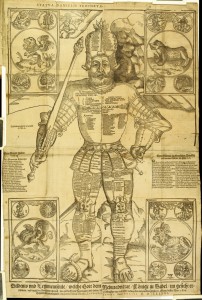
Woodcut of the statue described by the prophet Daniel, from Lorenz Faust’s Anatomia statuae Danielis (“An anatomy of Daniel’s statue”), 1585.
Woodcut, An anatomy of Daniel’s statue, 1585.

A collection of links for further reading for the British Library's Digital Scholarship course on 'Data Visualisation for Analysis in Scholarly Research'. I update this each time I teach the course, so please leave a comment if you know of any great sources I've missed. Slides and exercises for each version of the workshop are below. Many thanks to workshop participants for their feedback, as it directly helps make the next version more effective. And of course huge thanks to Nora McGregor and the British Library's Digital Scholarship team!

Last updated January 2018. Between course revisions I add interesting visualisations to my Scholarly Vision tumblr and pinboard.

Continue reading "Resources for 'Data Visualisation for Analysis in Scholarly Research'"

2012: an overview

An incomplete retrospective of what I got up to in 2012… For PhD updates, check my PhD.

In November 2012 I chaired a session on 'digital strategy’ at the Museums Association conference in Edinburgh and chaired the Museums Computer Group’s annual Museums on the Web conference at the Wellcome Collection on November 30.

In October I was in London for the Museum Ideas conference, Brighton for a Culture24 workshop on museums and web analytics then I headed off to Taiwan to give a keynote about open cultural data at the 'eCulture & Open Cultural Data Forum’ then lead a day and a half of seminars. I was also on a panel for Oxford ASPIRE on Living in the Digital World: Horizon Scanning for Museums and collaborated on a Guest post: Center for the Future of Museums blog.

In September I was in London for the AHRC Commodity Histories Project Networking Workshop 1, running a rather experimental session to come up with and verify the information architecture for the Commodity Histories site.

In July I was at Engaging digital audiences in museums, 11 July 2012, University of Manchester then in Hamburg for Digital Humanities 2012, where I ran a workshop on 'Learning to play like a programmer: web mash-ups and scripting for beginners', chaired the 'Methods’ session at another pre-conference workshop 'Here and There, Then and Now – Modelling Space and Time in the Humanities' and presented a short paper, 'On the Internet, nobody knows you’re a historian: exploring resistance to crowdsourced resources among historians' based on some early results from my PhD research. I was also interviewed for Museum ID magazine as part of a series of interviews with the 'alternative museum establishment’.

In June 2012 I spent a week as 'Scholar-in-residence’ at the Cooper Hewitt Museum in New York, then two weeks as a Fellow at the NEH Summer Institute on Deep Mapping and Spatial Narratives in Indianapolis.

In April I gave a Keynote: 'From Strings to Things’ at the Victorian Cultural Network Capacity Building LOD-LAM workshop in Melbourne, and was invited to give talks in Wellington (Te Papa) and Auckland (Auckland Museum) on 'What’s the point of a museum website?’ and 'Inspiring connections with collections’.

In March 2012 I was in Australia. I spent a week as geek-in-residence at the Powerhouse Museum, and I was in Canberra in late March for Digital Humanities Australasia 2012: Building, Mapping, Connecting to give a paper based on my PhD, called 'Why look a gift horse in the mouth? Exploring resistance to crowdsourced resources among historians’. I’ve posted summaries of the conference at Quick and dirty Digital Humanities Australasia notes: day 1, Quick and dirty Digital Humanities Australasia notes: day 2, Slow and still dirty Digital Humanities Australasia notes: day 3.

In February I ran a 45 minute workshop on 'lightweight usability testing’ at dev8D.

Blog posts for Open Objects included:

Panel: ASPIRE Digital Roundtable: "Horizon Scanning: Living in the Digital World"

I was invited to be a panellist for Oxford ASPIRE's first knowledge sharing event on 13th November 2012, Living in the Digital World: Horizon Scanning for Museums (PDF).  Oxford ASPIRE is a consortium of Oxford University Museums (the Ashmolean, Pitt Rivers, History of Science, Natural History Museums) and the Oxfordshire County Museums Service.

As they say in their post, ASPIRE Digital Roundtable: "Horizon Scanning: Living in the Digital World", 'This roundtable event brought together a small number of museum professionals to discuss how museums could thrive in the increasingly digital landscape by exploring innovations, opportunities for collaboration and funding sources.

Our 16 delegates gathered at the Pitt Rivers Museum and questions and ideas began bubbling immediately over coffee.  The event officially began with thoughts and provocations from our four expert panelists who gave their over-view of the key digital issues facing museums. Delegates and panelists then entered into a lively and illuminating conversation.' They've linked to podcasts and transcripts of the introductions in their post.

Workshop: exploring Neatline

A two-hour workshop for the University of Strathclyde, Glasgow, on Neatline.  Organised by Anouk Lang, it was their first digital humanities workshop and was designed as an opportunity to learn about Neatline and explore what it could (and couldn't) do.

Neatline workshop notes for the University of Strathclyde (PDF) Neatline workshop slides for the University of Strathclyde (Powerpoint)

Creative Commons Licence This work is licensed under a Creative Commons Attribution-ShareAlike 3.0 Unported License.

I've also written up some of my thoughts after the workshop at Reflections on teaching Neatline.